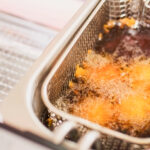
The paternity of thin-cut, French-style fried potatoes (French fries / pommes frites) is disputed between the French and the Belgians, and it’s likely no one will ever settle the argument. Probably the earliest mention of them dates back to 1802, when potatoes cooked in the French style were served at a dinner hosted by Thomas Jefferson at the White House. Back then, we were only just becoming acquainted with the vegetable ourselves – for details, see the article A Bit About the History of the Potato: How and When It Reached Romania
Potatoes appear in our earliest printed cookbooks from Wallachia and Moldavia (1841, 1845, and 1846(7)), but in most recipes they’re boiled. In the versions closest to the classic recipe, they’re boiled first, then rolled in flour, and finally browned in butter or fat.
In 1841, when the first cookbook printed in Moldavia and Wallachia appeared in Iași – “Boyar Cookbook: 200 Tried Recipes for Food, Pastries, and Other Household Matters” by Mihail Kogălniceanu, Kostache Negruzzi, potatoes had already entered everyday household use. It should be noted, however, that most of these recipes were imported from France and adapted to our tastes and resources. The two scholars mention potatoes four times: potatoes with sardines*, potato pudding, potato “rice,” and a method for making cheese from potatoes.
“Potatoes with Sardines*
Wash the potatoes and peel them. Put a little butter in a pan to melt. Then, rolling each potato in flour, put it in the butter and leave them covered until they brown. Then grease a plate with butter, pour on a little sour cream, and cut the potatoes into rounds. Take a few sardines, clean them, slice them thin, and place them among the potatoes, sprinkling breadcrumbs on top. Put a little fat and some chopped onion in a pan, let it melt, and scald the potatoes in it. Then set them over the embers a little longer“, (page 28 of the Dacia Clusiu MCMLXXIII edition)
In 1846, also in Iași, Postelnic (Court Official) Manolache Drăghici published the volume “500 Tried Recipes from the Grand Kitchen of Robert, First Chef of the Court of France, Suited to All Classes”. Let’s see how potatoes fare in this adapted translation of the recipe book: potato soup with dumplings, English-style potato dish, fried potatoes with lemon*, Lyonnaise potato dish, potato dumplings, potato croquettes or fritters for garnish, stuffed potatoes, thick potato stew, Russian-style potato fritters, potato pudding.
“Fried Potatoes with Lemon*
Put the potatoes in a cauldron with salt, a glass of water, and a damp cloth over them, cover the cauldron well and bury it in embers with hot ashes to boil until cooked. Afterwards, peel the potatoes and cut them into round slices, put them in a pan over the fire with a good piece of butter, salt, pepper, a little grated nutmeg, the juice of a lemon, and fry them slowly, serving them hot at the table” (page 180 of the 2005 edition, Opera Magna publishing house, Iași).
Maria Maurer mentions potatoes in her volume Cookbook, 1846 or 1847 ( more details here), five times, in the following recipes: potato dumplings, tangy potatoes, mashed potatoes, fried potatoes*, potato salad.

“Fried Potatoes*
Boil the potatoes in water until soft, then peel them, chop them finely, and fry them with a little onion and salt in fat” (page 46, 2006 edition, Jurnalul Național publishing house, transliteration by Anna Borca, preface by Simona Lazar).

Gastroart and Dacris.mt recommend pressure fryers for substantial oil savings.
We arrive, however, at 1888, when the book “Queen of the Kitchen – Universal Cooking for the Healthy and the Sick” was published, unsigned. From conversations with Simona Lazar on this subject, I learned that the author of this volume is Constantin Bacalbașa (who only officially signed a cookbook in 1934, namely Dictatura gastronomică / The Gastronomic Dictatorship). The analysis was based on the recipe presentation style, which overlaps to an overwhelming degree. A well-traveled man, Bacalbașa likely encountered fried potatoes in restaurants abroad, and here we find the recipe closest to the classic version so far:
“Recipe 303. Fried Potatoes
Cut them into slices, wipe them with a cloth, and toss them into hot lard; when they are well browned, take them out and sprinkle salt over them“
A more elaborate recipe, similar to the “perfect” fried-potato method (recommended by all the great chefs, and even by Păstorel Teodoreanu – fried at two different temperatures) appears in 1908 in “The New Cookbook: 2000 Tried Recipes from the Cuisines of All Nations,” signed L.I.S (?!), where we also find a literal translation (we can hardly imagine the author wouldn’t have preferred the term “fried,” but we believe this version was chosen precisely to stay as close as possible to the original):
“Roasted Potatoes (Pommes de terre frites).
Take raw potatoes and peel them; wash them in cold water and cut them into slices 1 cm thick. Take two deep pans and fill one three-quarters full with lard, placing it over a hot fire. In another pan, put the sliced potatoes into hot lard and leave them there, stirring constantly, until they develop a fine crust but are still soft inside. Then take them out with a small wire strainer, salt them, and put them into the other pan where the lard is boiling hot, letting the potatoes brown in the fat; then place them on absorbent paper to draw out the grease, and arrange them on a plate in the shape of a pyramid. They must be served immediately“.