Open fryers are used in almost every type of food service operation: fast food outlets, à la carte restaurants, cafeterias, and event venues. Designed for heavy daily use, they allow you to prepare a wide variety of menu items—from crispy or juicy, savory or spicy dishes, all the way to desserts.
With operating costs rising across all types of food production facilities, selecting the right equipment is increasingly important and can prove vital to the sustainability and success of your business.
Choosing a commercial fryer is a critical decision for any restaurant where fried foods play a prominent role on the menu. The right equipment influences not only food quality, but also speed of service, oil and energy consumption, operational costs, and overall kitchen efficiency.
A suitable fryer must meet your restaurant’s real-world demands during both quiet periods and peak rush hours. That is why your decision should not be based solely on price, vat capacity, or heating power.
In this article, we cover the most important criteria to consider when selecting a commercial fryer for your restaurant.
- Production Capacity – kg/hour
The first step is to establish your true production needs. The total amount of fried products in a day is important, but the ability to handle orders during peak hours is often decisive.
For example, two restaurants that each prepare 100 kg of fried products per day can have very different needs. If one distributes production throughout the entire day, while the other concentrates a large portion of orders into a two-hour window, the necessary equipment may be different.
To correctly size the fryer, you must take into consideration:
- The quantity of products prepared in a peak hour.
- Product type: frozen fries, breaded chicken, wings, fish, or other preparations.
- The weight of a batch and the duration of the frying cycle.
- The time needed for oil temperature recovery.
- The number of orders that must be prepared simultaneously.
It is important to request data from the manufacturer regarding production capacity in kg/hour, relative to the product and working conditions relevant to your restaurant. The theoretical capacity of the equipment does not automatically guarantee the same productivity in daily operation.
2. Electric vs. Gas Fryers
The choice of energy source influences operating costs, installation, and equipment performance.
Electric fryers offer precise temperature control and can represent a suitable solution for kitchens that have the necessary electrical infrastructure. Before purchasing, the available power, supply configuration, and compatibility with the existing system must be checked.
Gas fryers can be advantageous in high-consumption kitchens, especially when the cost of gas is competitive. However, the choice involves checking the connection, installation conditions, and exhaust and safety requirements.
For a correct comparison, it is not enough to analyze the energy price or nominal power. You must factor in thermal transfer efficiency, temperature recovery time, actual consumption, and installation costs.
The right solution is the one that offers the best balance between performance, total cost of operation, and available infrastructure.mal balance of performance, total cost of ownership, and available utility infrastructure.
3. Number and configuration of vats
The number of vats and their capacity must be chosen based on the menu and the workflow in the kitchen.
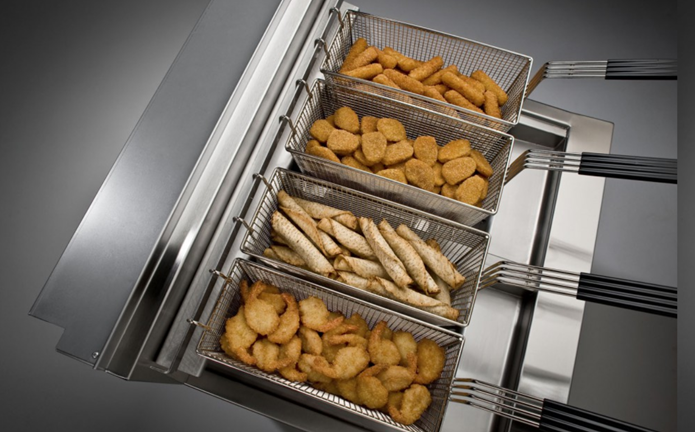
A fryer with a single large vat can be suitable for a restaurant that prepares significant quantities of the same product. In contrast, two independent vats allow the simultaneous preparation of different products and offer more flexibility in managing orders.
For restaurants with a high production volume, fryers with multiple vats or partitioned vats can contribute to organizing kitchen activity more efficiently.
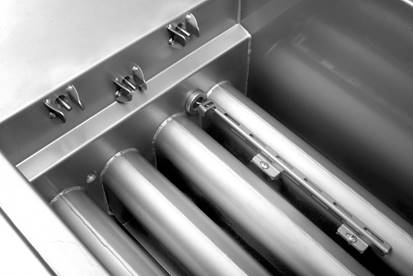
Another important aspect is the cold zone in the vat. This is the area located at the bottom of the vat, where the oil temperature is lower than in the main frying area. A portion of the food debris that falls from the basket during preparation accumulates in this zone. By limiting the exposure of these particles to high temperatures, the cold zone contributes to slowing down their burning and can help maintain oil quality for a longer time. The efficiency of this system depends on the vat construction and how heat is distributed, which is why it is worth considering when comparing different professional fryer models.
Among the advantages of a multi-vat configuration are:
- The possibility to prepare different products simultaneously.
- The separation of products that require different temperatures or times.
- The reduction of cross-contamination risk, under appropriate procedures.
- Easier adaptation to variations in demand.
- The possibility to use only the required vats when order volume drops, if the model permits this.
However, more vats do not automatically represent a better solution. The configuration must be correlated with production volume, available space, and acquisition and operating costs.tly.
4. Heating power and temperature recovery
An essential criterion in choosing a commercial fryer is the ability to maintain and recover oil temperature during use.
When you introduce frozen products or a large quantity of food into the vat, the oil temperature drops. The fryer must compensate for this drop in as short a time as possible, in order to sustain a constant frying process.
Insufficient temperature recovery can lead to longer preparation times, quality variations, and reduced productivity during busy periods.
To evaluate equipment performance, check:
- Heating system power and thermal transfer efficiency.
- Temperature recovery time after introducing a representative batch.
- Recommended quantity of product for each cycle.
- Temperature uniformity in the vat.
- Production capacity obtained under operating conditions comparable to those in your restaurant.
Power expressed in kW or BTU/h is a useful indicator, but it should not be analyzed separately from vat construction and the thermal performance of the equipment.
5. Oil filtration system
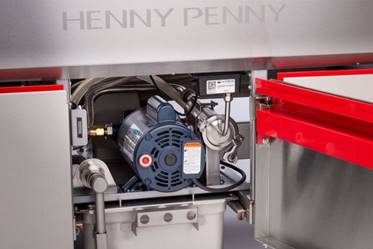
Oil represents a major recurring cost for restaurants that frequently prepare fried products. For this reason, the filtration system can have a significant impact on operating costs.
Regular filtration helps remove food particles that accumulate in the oil and can accelerate its degradation. However, the efficiency of the system also depends on product type, working temperature, filtration frequency, and how the fryer is used.
Depending on the model, you can opt for an integrated filtration system or an external one.
When evaluating the system, consider:
- Ease and speed of the filtration operation.
- The possibility of regular filtration without long interruptions to production.
- Cost and availability of consumables.
- Safety during hot oil handling operations.
- Ease of draining and cleaning the equipment.
Some professional fryers include automatic or assisted filtration functions, which can simplify operator activity and support compliance with maintenance procedures.
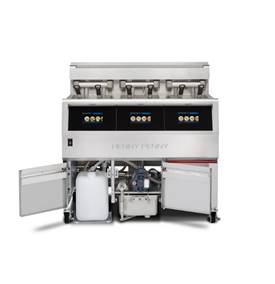
Henny Penny LOV Technology – less oil, higher efficiency
LOV (Low Oil Volume) technology from Henny Penny is designed to allow product preparation using a reduced volume of oil. Depending on the model and application, the manufacturer indicates a reduction in the amount of oil used by up to 40%, without reducing the amount of products prepared. This approach can contribute to lowering operating costs, especially in restaurants with a high volume of fried products. To evaluate the real benefits, it is important to choose the right model for the type of products prepared and to take into account the entire workflow, including oil filtration and maintenance.
A high-performance filtration system can contribute to reducing oil consumption, but the results depend on the entire workflow, not just the equipment used.
6. Automation and control features
In a professional kitchen, achieving consistent results is essential. Differences in experience among operators, high order volume, and time pressure can affect both food quality and productivity.
Automation features can help standardize the frying process and reduce manual interventions.
Useful features include:
- Frying programs with preset times and temperatures.
- Automatic basket lifting, where available.
- Automatic or assisted oil filtration systems.
- Overheating protection systems and other safety devices.
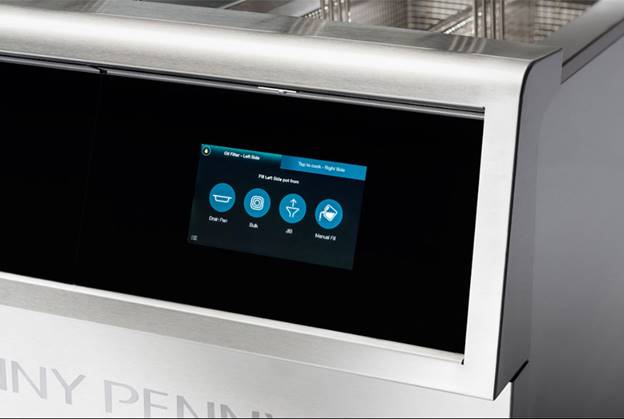
These features can be particularly useful in high-traffic restaurants, QSR-type units, and restaurant chains where process standardization is important.
Before purchasing, analyze which features are truly necessary and what operational benefits they can bring. More automated equipment may have a higher initial price, but it can contribute to streamlining activity and achieving more consistent results.
7. Dimensions, installation, and ease of maintenance
Even a fryer with very good technical performance can become an unsuitable choice if it does not integrate correctly into the available space.
Before ordering, check the dimensions of the equipment, the space needed for operation, and access to components that need to be cleaned or maintained periodically.
You should also keep in mind:
- Electrical power supply or gas connection requirements.
- Compatibility with the ventilation and exhaust system.
- Space required for door opening and basket handling.
- Access for oil draining and vat cleaning.
- Installation and commissioning conditions.
- Technicians’ access for interventions and maintenance.
Good ergonomics can reduce the time allocated to daily operations and can improve staff workflow.
At the same time, ease of cleaning is an important criterion for maintaining hygiene and complying with food safety procedures.
8. Purchase price and total cost of ownership
The purchase price is important, but it alone does not reflect the real cost of a commercial fryer.
A model with a lower initial price can generate higher expenses over time, depending on energy consumption, the amount of oil used, maintenance needs, and the availability of spare parts.
For a correct evaluation, include in your calculation:
- Cost of equipment and accessories.
- Transport, installation, and commissioning.
- Energy consumption under real working conditions.
- Annual oil consumption.
- Cost of consumables and maintenance operations.
- Service costs and spare parts.
- Impact of potential unplanned downtime on restaurant activity.
For example, for a unit with a high production volume, constant savings on oil or energy can become significant over the lifespan of the equipment.
At the same time, service availability and response speed must be carefully evaluated. In a busy kitchen, the unavailability of a fryer can directly affect service time and the restaurant’s capacity to fulfill orders.
Conclusion: how do you choose the right commercial fryer?
Choosing a commercial fryer must start from real production requirements and continue with evaluating thermal performance, vat configuration, filtration system, automation features, and operating costs.
There is no universal model suitable for all restaurants. The optimal solution depends on the type of products prepared, order volume, available space, kitchen infrastructure, and the operator’s efficiency goals.
A correctly sized fryer can contribute to obtaining consistent quality products, organizing activity more efficiently, and controlling costs over the long term.
Need help choosing a commercial fryer?
The Dacris team can help you identify the right solution for your restaurant’s specifics, based on production volume, dish types, and operational kitchen requirements.
Contact us to discuss the right equipment for your project.
Dacris – professional equipment for HoReCa kitchens.