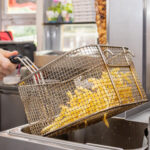
Deep frying remains one of the most widely used cooking methods in the HoReCa industry due to its speed, versatility, and ability to deliver products with a crispy texture and a taste appreciated by consumers. From French fries and breaded products to premium fried chicken, the success of many restaurant concepts directly depends on the performance of frying equipment.
In any modern professional kitchen, the deep fryer is one of the most important pieces of equipment for operational efficiency and food quality. Whether you run a fast-food restaurant, a chicken restaurant, or a high-volume kitchen, choosing the right type of deep fryer can directly impact costs, productivity, and customer satisfaction.
In 2026, the market offers three main categories of professional deep fryers: open deep fryers, pressure deep fryers, and rapid deep fryers. Each has specific advantages and applications.
Why is choosing the right fryer important?
A professional fryer is not just about cooking food in oil. The right choice can help:
- reduce energy consumption;
- extend the life of the oil;
- increase the speed of service;
- ensure consistent quality and standardization of dishes;
- reduce product losses;
- optimize operating costs.
The type of fryer chosen must be consistent with the menu, production volume and business objectives.
Modern fryers offer multiple optimization possibilities by introducing programmable control panels, integrated oil filtration systems, more efficient control of working parameters and, above all, reliability and durability.
The use of preset programs and intuitive use reduce training time – an advantage especially in restaurants that face staff fluctuations. Oil filtration systems substantially reduce oil consumption and precise control of working temperature reduces energy consumption.
Open professional fryer
The open fryer is the most common solution in restaurants and fast-food establishments. Open fryers offer a higher level of versatility and allow for the development of a diversified menu.
How does it work?
The preparations are placed in an open oil bath. The frying process takes place at normal atmospheric pressure.
Advantages
- High versatility for various types of preparations.
- Simple and intuitive operation.
- Lower acquisition cost compared to other technologies.
- Easy maintenance and cleaning.
These are ideal for preparing products such as:
- crispy strips;
- chicken tenders;
- chicken sandwiches;
- nuggets;
- french fries;
- baked goods;
- fish and seafood;
- snacks and appetizers.
Recommended for:
- quick service restaurants;
- a la carte restaurants;
- event halls, canteens or restaurants with high production capacity;
- burger restaurants;
- cafes and bistros.
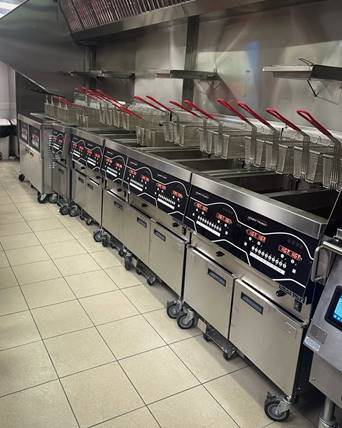
Open fryers can be either with or without a cold zone.
Depending on the menu items being prepared, choosing the right one between the two can dramatically change the finished product. In addition, an integrated oil filtration system, capable of cleaning impurities quickly, in perfect safety conditions, will provide a major competitive advantage.
For operators who handle multiple product categories simultaneously, high-capacity open fryers offer an additional advantage: the ability to maintain oil quality and food consistency even during peak periods. This allows for menu expansion without compromising production speed or customer experience.
https://www.dacris.mt/categorie/friteuze-deschise/
The latest generation technology used by Henny Penny offers multiple advantages:
- Extremely short recovery time
- Super fast filtration, using a high capacity pump
- Protection of the oil against unnecessary burning
- Reduction of energy consumption
- Strict control of the working temperature
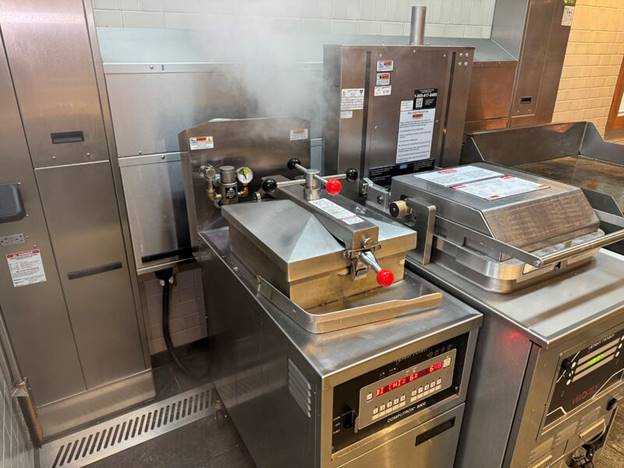
Professional pressure fryer
Pressure frying has revolutionized the way professional kitchens work, thanks to its many advantages.
Henny Penny introduced the world’s first commercial pressure fryer in 1957.
The pressure fryer is considered the premium standard for chicken dishes and is widely used by major international chains.
https://www.dacris.ro/categorie/bucatarie-calda/friteuze/friteuze-sub-presiune
How does it work?
By increasing the pressure inside the tank, the boiling point of the water in the product changes, allowing faster cooking and reducing moisture loss.
During the cooking process, the lid of the fryer closes hermetically and the internal pressure is automatically controlled. This process allows the products to be cooked at a lower temperature and in a shorter time, maintaining the natural moisture of the meat. This results in a juicy product on the inside and a crispy crust on the outside, significantly reducing the amount of oil absorbed inside the product.
Advantages
- Foods stay juicier and more tender.
- Reduced cooking time.
- Better finished product yield.
- High finished product consistency.
- Longer oil life.
- Excellent productivity during peak periods.
- Why do restaurants choose pressure fryers?
For operators who base their meals on bone-in chicken, the pressure fryer remains one of the most efficient solutions available. It offers a high level of standardization and allows the same quality to be maintained regardless of volume or staff changes.
Recommended for:
- Fried chicken restaurants;
- Quick Service Restaurant (QSR) chains;
- High volume production facilities;
- Operators who seek maximum standardization.
- A technology built for long-term performance
Over time, leading manufacturers have constantly refined this technology to meet the real needs of HoReCa operators: high productivity, controlled costs and reliability under intensive use conditions.
The level of pressure created inside the tank is extremely important.
Henny Penny pressure fryers operate at a standard operating pressure of 12 psi (approximately 0.83 bar), a value optimized for fast preparation of products and maintaining their juiciness.
Impact on oil consumption: an often underestimated criterion
When choosing a professional fryer, many operators focus on capacity, production speed or the initial cost of the equipment. However, one of the most important long-term expenses in a professional kitchen is oil consumption.
The way the fryer operates directly influences how quickly the oil degrades, how often it needs to be filtered and replaced and how consistent the results obtained are.
Why do pressure fryers protect oil better?
A major advantage of pressure frying technology is that it allows products to be cooked at lower temperatures than many conventional frying processes.
Due to the controlled environment and efficient heat transfer, foods can reach optimal cooking without having to expose the oil to excessive temperatures. This reduces thermal stress on the oil and slows down the degradation process.
For operators, the benefits are significant:
- longer oil life;
- reduced frequency of complete oil changes;
- lower operating costs;
- consistent performance throughout the day;
- more uniform food quality.
Fewer fluctuations, more consistent results
In addition to optimized operating temperatures, modern pressure fryers use electronically controlled cooking programs that reduce temperature variations and excessive heat recovery cycles.
This precise control helps both maintain the quality of the final product and protect the oil from premature wear. Instead of being subject to constant fluctuations, the cooking environment remains stable and predictable.
For restaurants with high production volumes, this consistency makes it easier to plan oil consumption and provides better control over operational costs.
Long-term savings
Differences in consumption may seem minor on a working day, but over the course of a year the financial impact becomes considerable. Reducing the number of oil changes, together with optimizing energy consumption and preparation times, can significantly contribute to lowering the total operating cost of a professional fryer.
For this reason, when analyzing the investment in new equipment, it is recommended to consider not only the purchase price, but also the costs associated with consumables and long-term operation.
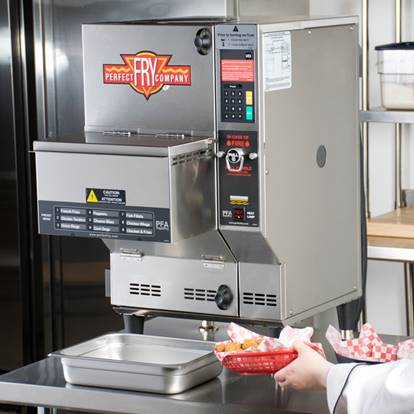
The fast fryer – the solution for small spaces and ultra-fast serving
As the HoReCa industry seeks solutions to optimize space and reduce service times, deep fryers have become an increasingly popular category in restaurants, gas stations, convenience stores and grab-and-go concepts.
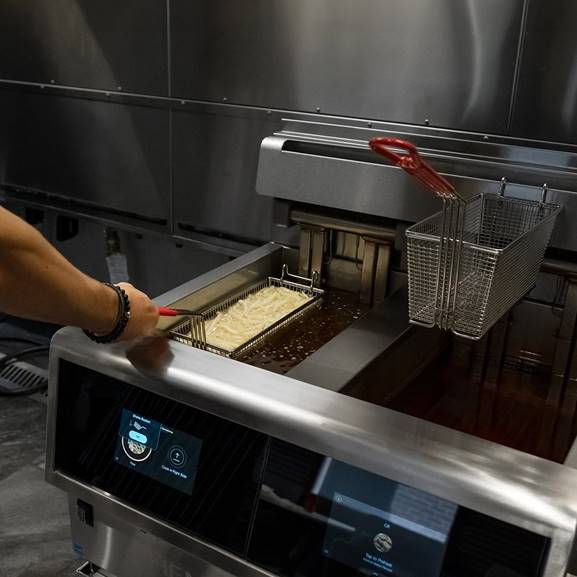
Unlike traditional deep fryers, these equipment uses advanced cooking technologies in a closed chamber, combining high cooking speed with a higher level of safety and automation.
How does it work?
Rapid fryers are designed to cook products in a controlled environment, where the operator has minimal contact with the hot oil. Products are placed in dedicated compartments, and cooking cycles are automatically managed by preset programs.
This system reduces the risk of human error and allows for consistent results regardless of the experience level of the staff.
Advantages
- Very short preparation time.
- Simplified operation.
- High level of safety for personnel.
- Compact dimensions.
- Reduced odors and fumes compared to traditional systems.
- Requires minimal operator training.
- Consistent results from one order to another.
Why do operators choose fast frying technology?
One of the most well-known technologies in this category is developed by Perfect Fry, a manufacturer specializing in automatic frying equipment for locations where available space and speed of service are critical factors.
These systems are designed to allow rapid preparation of products such as:
- chicken tenders;
- nuggets;
- wings;
- french fries;
- breaded products;
- frozen snacks;
- appetizers and snacks.
Being fully automated, they help reduce dependence on specialized personnel and allow the same quality standards to be maintained even in locations with staff fluctuations.
A smart choice for locations without a full kitchen
One of the main advantages of Perfect Fry technology is the possibility of implementation in a wide range of concepts that do not have a traditional professional kitchen.
Therefore, this equipment is frequently used in:
- gas stations;
- convenience stores;
- food courts;
- food kiosks;
- hotels;
- quick service areas;
- locations with limited space for production.
Through the combination of automation, safety and productivity, rapid fryers allow the expansion of food offerings without major investments in the infrastructure of a classic kitchen.
Recommended for:
- convenience stores;
- gas stations;
- cafes and bistros;
- hotels;
- food courts;
- grab-and-go concepts;
- locations with reduced staff;
- operators aiming for quick service and streamlined processes.
Comparison of types of professional fryers
| Characteristic | Open Fryer | Pressure Fryer | Rapid Fryer |
|---|---|---|---|
| Speed | Good | Very good | Excellent |
| Versatility | Excellent | Average | Good |
| Bone-in chicken | Good | Excellent | Limited |
| Operating cost | Medium | Low | Low |
| Required space | Medium | Medium | Low |
| Fryer Type | Ideal For | Investment | Productivity |
|---|---|---|---|
| Open | Varied menu | €€ | ★★★★★ |
| Pressure | Premium fried chicken | €€€ | ★★★★★ |
| Rapid | Limited spaces and grab-and-go | €€€ | ★★★★☆ |
How does the type of fryer influence menu development?
In the context of a constantly changing HoReCa market, restaurants are constantly looking for ways to diversify their offer without increasing the complexity of kitchen operations. Choosing the right professional fryer can have a direct impact on the flexibility of the menu and on the team’s ability to deliver consistent dishes, regardless of volume.
A high-performance equipment not only contributes to the efficiency of the cooking process, but also offers the possibility of introducing new product categories that respond to current consumer trends.
What criteria should you consider before purchasing?
- Daily production volume
A restaurant that serves 50 servings per day has different needs than one that produces 500 or 1,000 servings per day.
- Main type of food
For French fries and frozen products, an open or rapid fryer may be the ideal choice. For premium fried chicken, pressure models offer superior results.
- Operating costs
In the long run, energy and oil consumption can have a greater impact than the purchase price of the equipment.
- Available space
The size of the kitchen influences the choice of fryer capacity and configuration.
- Automation capabilities
Modern models offer preset programs, automatic oil filtration, digital monitoring, and connectivity for operations management.
An Investment That Supports Business Growth
A high-performance fryer is not just a cooking appliance, but a central element of the operational flow. When the temperature is stable, preparation times are predictable, and the team can focus on the quality of the dishes and the customer experience.
Over time, these advantages contribute to reducing interruptions, increasing efficiency and maintaining a constant work pace – essential aspects for any restaurant that aims for long-term growth and profitability.
The investment in a professional fryer should be evaluated not only in terms of the purchase price, but also in terms of long-term reliability, service availability and the reputation of the manufacturer.
| Open Fryer | Pressure Fryer | Rapid Fryer |
|---|---|---|
| Flexibility | Premium chicken quality | Automation |
| Varied menu | Reduced oil cost | Small footprint |
| Moderate investment | High productivity | Minimal labor |
Conclusion
There is no one professional fryer that is perfect for all types of restaurants. The ideal choice depends on the menu served, production volume and operational objectives.
Open fryers offer flexibility and affordable costs, pressure fryers excel in preparing premium fried chicken, and rapid fryers are the optimal solution for locations with space limitations and the need for standardization under high safety conditions in operation.
Consulting a supplier specialized in premium restaurant equipment can help identify the ideal configuration so that your investment generates performance and profitability in the long term.
If you want to identify the most suitable solution for your restaurant, our specialists can help you compare available technologies and choose the optimal configuration based on your menu, production volume and operational objectives.